![[personal profile]](https://www.dreamwidth.org/img/silk/identity/user.png) radiantfracture
radiantfractureIn the week between classes, I've been trying to take proper long rambles each day, to make more space in my head and all the spaces in me.
Trying isn't the word, really. I'm compelled up and out of the house to wander the earth. Fortunately this bit of the earth is damn pretty right now.
Here, then, are some photos from various park-hunting expeditions of the last few days, organized around the theme of awesome local species rather than chronology, because I'm too tired to explain the chronology.
Probably the plant most associated with this region is purple camas, a long-time indigenous food crop that has become rare because of habitat destruction. Camas grows in Garry Oak meadow ecosystems, which, rather than rainforest, is the distinctive landscape of this area. (Garry Oak is known as Oregon White Oak in the U.S., but we don't call it that, because Canada.)
This is a Garry Oak meadow restoration site. The blue isn't bluebell, but camas.
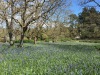
You aren't alloweded to pick or eat camas, unless for traditional use, because it's endangered, and it's fragile enough that you shouldn't walk through the meadow while it's blooming. I was on a roped-off path.
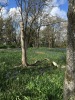
Here is a mix of camas and local Easter lilies:
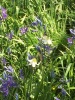
This shows off the buttercups more than the camas, but I liked it:
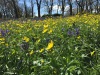
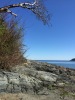
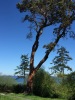
And here are some photos from Arbutus Cove, though it wasn't very arbutussy. (The arbutus is the same tree as the madrone in California, but we don't call it that, see above.)
{rf}
Trying isn't the word, really. I'm compelled up and out of the house to wander the earth. Fortunately this bit of the earth is damn pretty right now.
Here, then, are some photos from various park-hunting expeditions of the last few days, organized around the theme of awesome local species rather than chronology, because I'm too tired to explain the chronology.
Probably the plant most associated with this region is purple camas, a long-time indigenous food crop that has become rare because of habitat destruction. Camas grows in Garry Oak meadow ecosystems, which, rather than rainforest, is the distinctive landscape of this area. (Garry Oak is known as Oregon White Oak in the U.S., but we don't call it that, because Canada.)
This is a Garry Oak meadow restoration site. The blue isn't bluebell, but camas.

You aren't alloweded to pick or eat camas, unless for traditional use, because it's endangered, and it's fragile enough that you shouldn't walk through the meadow while it's blooming. I was on a roped-off path.

Here is a mix of camas and local Easter lilies:

This shows off the buttercups more than the camas, but I liked it:

And here are some photos from Arbutus Cove, though it wasn't very arbutussy. (The arbutus is the same tree as the madrone in California, but we don't call it that, see above.)


{rf}


no subject
Date: 2017-04-27 06:38 am (UTC)The second of these is just very beautiful, color and composition.
no subject
Date: 2017-04-27 02:02 pm (UTC){rf}
no subject
Date: 2017-04-27 08:32 am (UTC)no subject
Date: 2017-04-27 08:35 am (UTC)no subject
Date: 2017-04-27 09:19 am (UTC)no subject
Date: 2017-04-27 05:58 pm (UTC)no subject
Date: 2017-04-27 06:01 pm (UTC)no subject
Date: 2017-04-27 09:59 am (UTC)Is there a close-up photo of camas somewhere? I'd like to be able to identify it if I'm ever in its vicinity.
no subject
Date: 2017-04-27 02:06 pm (UTC)no subject
Date: 2017-04-27 02:42 pm (UTC)no subject
Date: 2017-04-27 12:37 pm (UTC)no subject
Date: 2017-04-27 03:16 pm (UTC)no subject
Date: 2017-04-27 05:50 pm (UTC)a) Ursula K. Le Guin, or
b) The Arbutus/Madrone Files: Reading the Pacific Northwest by Laurie Ricou.
{rf}
no subject
Date: 2017-04-27 06:50 pm (UTC)no subject
Date: 2017-04-28 01:54 am (UTC)no subject
Date: 2017-04-29 01:10 am (UTC)